
Planting trees in a wildflower meadow
Today I want to share something that sits right on the edge of rewilding — planting trees in a wildflower meadow.
I’m standing here in the meadow we started almost four years ago when we moved in. We created it in the simplest way possible: by leaving the grass to grow long over summer.
Watch the video and read on for more details:
I’ve made several videos about this over the past year, so do check them out if you haven’t already. But as my understanding of wild ecosystems has deepened, I realised I want to make a few adjustments to our meadow — and that’s what I’m sharing with you today.
Why add trees to a wildflower meadow?
In my talk on gardening for wildlife, I explained how we once assumed prehistoric Britain was dominated by dense woodland with small pockets of meadow. But thanks to ecologists like Frans Vera, there’s now a strong case that the landscape may have been more like open-canopy woodland — a mixture of trees, light, grasses, and grazing animals.
In other words, plenty of trees, but spaced widely enough for sunlight to reach the ground, allowing grasses, wildflowers, and rich biodiversity to thrive.
Large herbivores would have played a key role too, browsing young saplings and preventing the formation of dense, closed canopy forest.
Choosing the right trees for your meadow
When we first moved in, I planted a few apple trees. But I now want to take this idea further and add more trees — without overwhelming the meadow. Tree choice is crucial. We have a small garden, and the goal is to increase biodiversity, not shade out the wildflowers.
Logic might say “only plant small trees,” but many of the trees that support the most wildlife — especially species like oak — grow very large when mature.
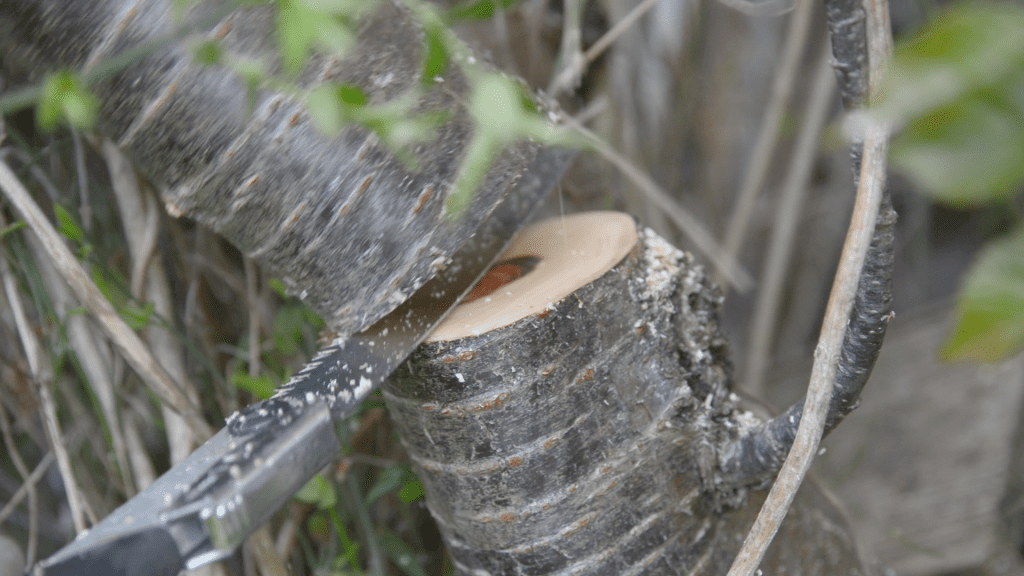
This is where the idea of planting trees that tolerate coppicing becomes incredibly useful when planting trees in a wildflower meadow.
Coppicing: A tool for meadow-friendly trees
Coppicing, used for thousands of years, simply means cutting a tree back to the ground every few years. Depending on your needs, this can be:
every 1–2 years for thin plant supports
every 20 years for larger poles
or even 50–100 years for significant timber
By choosing trees that respond well to coppicing, we can prevent them from overpowering the meadow. If the grasses and wildflowers ever begin to look overshadowed, we simply cut the trees back and let them regrow. It’s a dynamic, flexible system — and it mimics natural grazing cycles.
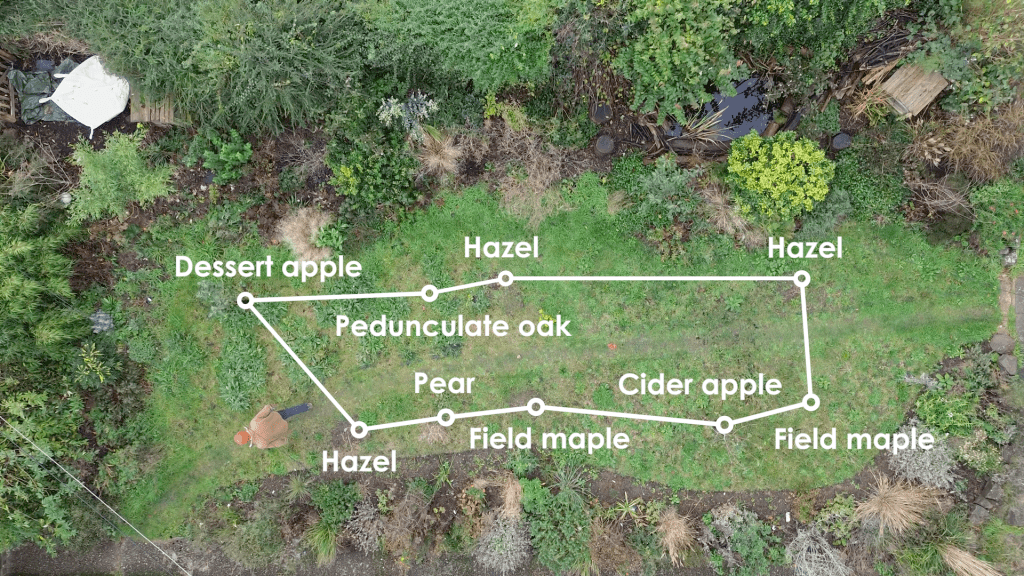
Yesterday I picked up some bare-root saplings from the local garden centre, sold as hedging plants, at just £2.50 each. Far cheaper than mature trees! I chose hazel and field maple, but to be honest, most native trees coppice well because they evolved alongside herbivores that frequently browsed their seedlings.
Planting your trees
Planting trees in a wildflower meadow is simple:
Dig a small hole
Plant your tree
Give it a good water
Smaller species like hazel, hawthorn, and field maple can be planted every few metres in irregular, naturalistic spacing. Some can be close together; some far apart. A little randomness is important — it avoids the look of an orchard and helps recreate that semi-wild, open woodland feel.
If you have a larger area, big species like oak or lime can be planted 20–50m apart and either grown to maturity or coppiced periodically.
Here in our garden, I transplanted an oak sapling earlier this year. I’ll probably coppice it in about ten years because our space isn’t huge, but it will still provide incredible habitat value in the meantime.
Should you plant trees in your wildflower meadow?
If you already have a meadow, it’s worth considering whether adding a few native trees could take your rewilding efforts to the next level. Thoughtfully planting trees in a wildflower meadow can:
increase structural diversity
create habitat for more species
provide shade and shelter
add seasonal interest
and mimic natural ecosystems more closely
It’s a gentle, ecological way to enrich your landscape without losing the magic of your wildflower meadow.
Will you be planting more trees in your garden?
Has this video encouraged you to plant some more trees in your garden? I hope so 😊
Please do let me know your thoughts and plans for this. I’d love to hear from you.
Happy wilding.
Joe

Joe Vary Dip. Hort (Wisley), MCIHort, CMTGG
I'm a gardener, educator, consultant, and planting designer. Learn with me 1-to-1, or join my mentoring group and community.
This Post Has 3 Comments
The video has actually made me wish I had a slightly bigger garden.!,
Every time you produce a video Joe you give me more ideas that I feel excited to try. I appreciate the fact that you have shown how even a small, garden can have for example a meadow – which I have now planted. I also have lovely airy plants and I am trying to find a suitable spot for a small pond – and now ———- any more trees?? Is it worth replacing some of my ‘common ‘ shrubs with trees or is that counter productive ? Is it possible to get to saturation point in your garden ( especially a fairly small one) where you just have to be satisfied that you have a good balance? I just think when you hear new ideas it is hard not to try to put them in to practice!
Hi Jo,
Thanks for such a great comment. Yes, it’s definitely possible to get to saturation point (in different ways).
For example, saturation point with trees looks like a garden that doesn’t receive enough light at ground level. This reduces biodiversity; and life that does exist tends to live higher up in the tree canopy.
That said, closed-canopy woodland is a habitat that would have been present and valuable in the UK say 8,000 years ago. To what extent it was present… we don’t know.
It’s likely that many of the shrubs you already have are valuable to wildlife. Take a look at them when they’re flowering and fruiting. Are animals enjoying them? If yes, you could probably leave them. You can always remove or prune some shrubs to make room and increase the variety of plant forms present, if you feel this is needed.
Not every garden needs trees. If your garden is very small, it may be difficult to work trees in. That said, “coppiceable” trees like hazel work well. You could always try and squeeze a hazel between your two fruit trees and cut it down every few years 😊
You used the word balance. That’s important. Your garden has to work for you, and if you’re observant and make adjustments as you see fit, you’ll usually end up with a balanced garden that fits with your lifestyle and preferences.
Best wishes,
Joe
Thanks Joe for your response. I feel encouraged. The winter days are giving me time to ‘mull over’ what next!